How to Plant and Grow Japanese Stewartia
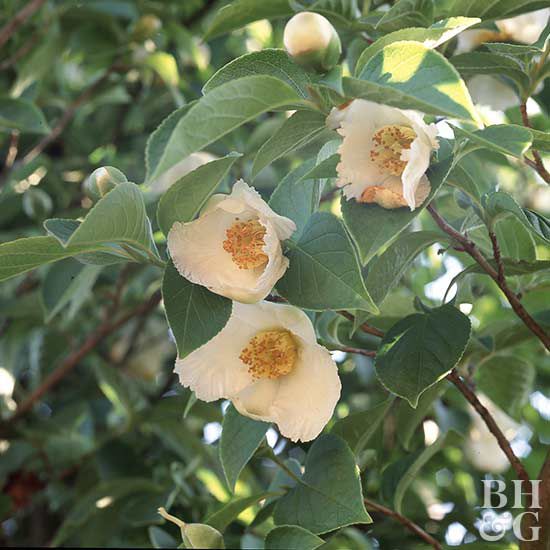
Japanese stewartia provides a show for every season. Clean green foliage covers this small tree in springtime, creating the perfect backdrop for stewartia's camellia-like flowers in early summer. The showy blossoms begin as large marble-shape white buds. The sprouts open to reveal white cup-shape flowers with bright orange centers. As summer turns to fall, stewartia foliage turns shades of bronze and purple to usher in the season. After the leaves drop, this small tree's peeling bark takes center stage. The reddish-brown bark provides interest through winter.
Japanese Stewartia Overview
| Genus Name | Stewartia pseudocamellia |
| Common Name | Japanese Stewartia |
| Plant Type | Tree |
| Light | Part Sun |
| Height | 12 to 40 feet |
| Width | 8 to 25 feet |
| Flower Color | White |
| Foliage Color | Blue/Green |
| Season Features | Colorful Fall Foliage, Summer Bloom, Winter Interest |
| Zones | 5, 6, 7, 8 |
| Propagation | Seed, Stem Cuttings |
| Problem Solvers | Slope/Erosion Control |
Where to Plant Japanese Stewartia
Plant Japanese stewartia in full sun or part shade and moist, organically rich, well-drained soil. Slow growing and reaching a height of 15 to 30 feet tall and 20 to 25 feet wide at maturity, it's a good fit for small landscapes. Because it is a multiseason-interest plant, Japanese stewartia is an excellent specimen plant for a front yard or a focal point plant near a patio or outdoor room. Pair this easy-care tree with low-maintenance shrubs, such as shrub roses, ninebark, viburnum, and spirea, to create a hardworking planting area that requires little effort.
How and When to Plant Japanese Stewartia
Plant Japanese stewartia in spring or early summer. Stewartia is commonly sold as a large, multistem shrub, as well as a tree. Check your local nursery for plant forms available in your area.
Potted specimens require a planting hole roughly twice the size of their root ball. Amend the backfill with compost. Remove the plant and loosen the roots a bit from the root ball before placing in the hole at the same depth as it is in the pot. Backfill with amended soil, tamp lightly, and water well to remove air pockets. Water regularly as the roots take hold.
Space multiple trees 12 to 25 feet apart depending on whether you're planting a multi-stem shrub or a single trunk tree.
Japanese Stewartia Care Tips
Light
Japanese stewartia grows best in full sun. In regions with warm summers, plant it in a protected location where it will receive shade from intense afternoon sun—the east or north side of a house or building is a good choice.
Soil and Water
Japanese stewartia thrives in moist, well-drained soil rich in organic matter. Sandy or loamy soils are best with an acidic to neutral pH range.
Water plants regularly during the first year after planting to encourage a deep, extensive root system. Continue to water deeply during extended dry periods.
Temperature and Humidity
Japanese stewartia tolerates cold winters down to zone 5. Mulch around the root zone in colder months and protect the tree from drying winter winds. In the hot, humid climates of its southern range, the tree performs best with afternoon shade.
Fertilizer
Fertilize Japanese stewartia once in the spring using a balanced, granular fertilizer. For the amount to use and application process, follow product label directions.
Pruning
Japanese stewartia doesn't need regular pruning but, like most shrubs and trees, you should remove any branches that break or cross each other. Winter is the ideal time to prune but anytime after flowering is fine. The bark of this tree is thin and easy to injure, so be careful with pruning equipment and when mowing near the trunk.
Potting and Repotting Japanese Stewartia
As a tall multi-stemmed shrub or small tree, Japanese stewartia is not suitable for growing in pots.
Pests and Problems
Japanese stewartia has no serious insect or disease issues. This slow-growing tree does take a while to develop a sturdy root system, however, so it's a good idea to brace it to withstand winds during its first few growing seasons.
How to Propagate Japanese Stewartia
Growing Japanese stewartia from seed is a chancy business as it requires several levels of stratification. You may have as successful a result if you wait for self-seeded plants to appear in the landscape and transplant those. The most reliable method of propagation, and one that assures your plant will be identical to its parent is via stem cuttings.
Take several soft-wood cuttings in early summer or semi-hardwood cuttings in mid- or late summer. With sterilized pruners, snip off a 3- to 5-inch cutting and remove all but the top few leaves. Scrape the bark off the cut end and dip it into rooting hormone. Place the cut end into a pot filled with moistened potting mix and firm the medium around the stem. Put the potted cutting in bright, indirect light, keeping the soil moist. Place the pot in a cool spot (around 40 degrees is ideal) for the winter. If your cutting roots, the sapling can be planted in the garden in the spring.
Types of Japanese Stewartia
'Milk and Honey' Japanese Stewartia
'Milk and Honey' stewartia is known for its profuse display of flowers, its bright bark color, and the vivid orange red fall foliage.
'Cascade' Japanese Stewartia
'Cascade' is a semi-weeping form with drooping branches and red-purple fall foliage.
'Pilar Bella' Japanese Stewartia
'Pilar Bella' features large flowers on a columnar-shaped tree.
Japanese Stewartia Companion Plants
Spirea
Spirea is a diverse group of flowering shrubs that comes in many sizes, colors, and forms. Plus, they're easy-to-grow plants that are hardy in most regions of the country. Spireas are very fast-growing. Among the types of spirea available, Japanese spirea is known to have good deer resistance. It also attracts bees, butterflies, and other beneficial insects. Zones 4-10
Ninebark
Ninebark (Physocarpus spp.) is an extremely versatile plant. Its fast-growing habit and appealing winter bark makes ninebark shrub a garden favorite. The traditional ninebark foliage color is a deep purple, but new foliage colors include gold and amber. Some varieties even fade from one color to another as they age. Zones 3-7
Shrub Rose
There are landscape-worthy roses that don’t require constant devotion. Some of the best fall into the aptly-named shrub rose class. This group includes roses like Knock Out, which create color blocks of bloom almost all season and require almost no care. It’s also the place to look for some of the most cold-hardy roses for northern gardens, such as the Canadian Explorer Series. Even gardeners mostly interested in luxurious fragrances and blooms will find some of their best picks among the English shrub roses, which include several of the most fragrant roses ever bred. Zones 3-10
Frequently Asked Questions
- How long does stewartia bloom?
Japanese stewartia generally blooms June to August and over a 3-4 week period rather than all at once. Flowers are followed by brownish-green woody fruits that disperse their seeds in a burst.
- What’s the lifespan of Japanese stewartia?
When grown in an optimal environment, Japanese stewartia may live for 70 to 150 years. It needs time to grow, reaching only about 12 feet after 10 years and topping out at about 30 feet after 25 years.
- Where does the name "stewartia" come from?
Stewartia pseudocamillia is named for John Stuart, a 16th-century Scottish botanist and 3rd Earl of the Isle of Bute. The species name pseudocamillia (“false camillla”) comes from the tree's flowers, which strongly resemble those of camellia shrubs. In fact, the Japanese name for stewartia, natsu tsubaki, means “summer camellia.”