How to Plant and Grow Hackberry
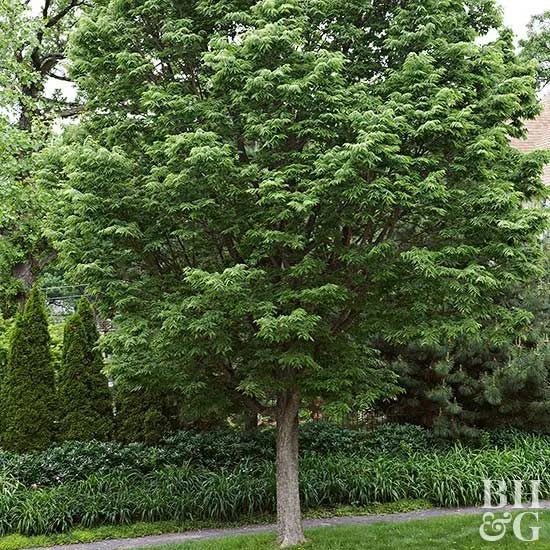
Native to central and northeastern North America, hackberry is one of the toughest and most adaptable deciduous trees you can plant.
Its bright green leaves turn yellow in autumn. Though not known for fall color, the tree produces sweet, edible fruit that attracts birds and other wildlife such as squirrels. The dark red or purple drupes (berries) mature in late summer or early fall and persist on the tree through winter. It also has an interesting bark. Young branches sport corky outgrowths, while older bark features a unique warty, sometimes scaly, look.
Hackberry grows at a moderate rate of 12 to 15 inches per year.
Hackberry Overview
| Genus Name | Celtis occidentalis |
| Common Name | Hackberry |
| Additional Common Names | Common Hackberry, American Hackberry, Northern Hackberry |
| Plant Type | Tree |
| Light | Sun |
| Height | 30 to 50 feet |
| Width | 25 to 45 feet |
| Flower Color | Green |
| Foliage Color | Blue/Green |
| Season Features | Spring Bloom, Winter Interest |
| Special Features | Low Maintenance |
| Zones | 2, 3, 4, 5, 6, 7, 8, 9 |
| Propagation | Seed |
| Problem Solvers | Drought Tolerant, Good For Privacy |
Where to Plant Hackberry
A location in full sun is best but other than that, hackberry is very adaptable to soil types, pH range, and site conditions.
Hackberry makes a good shade tree. It is well-suited as a windbreak because its branches won't break easily even in strong winds. You can also plant it for erosion control. Because it is a large tree that grows nearly as wide as tall, it looks best in a naturalized landscape with other resilient trees.
How and When to Plant Hackberry
If you purchase hackberry as a bare-root tree, plant it in the early spring so it has the entire growing season to develop a strong root system. Trees in nursery pots can still be planted later in the spring.
Dig a planting hole that is at least twice as wide and 6 inches deeper than the plant's root ball. Position the tree in the planting hole so the top of the rootball is level with the surrounding grade. Backfill with the original soil. Water the newly planted tree regularly during the first year after planting—about 1 inch per week.
Hackberry Care Tips
Hackberry lives up to its reputation of being a very tough tree, which also means it grows with very little care.
Light
While hackberry can also grow in partial shade, it should be planted in a location where it gets at least 6 hours of full sun every day.
Soil and Water
Hackberry grows best in moist, well-drained organically rich soil with a pH between 5.0 and 8.0 but it is quite adaptable. The tree also tolerates a wide range of wet and dry soil conditions, including clay and limestone—in fact, the tree often naturally occurs in limestone soil with a high pH.
Watering is only required during the first year. The established tree is considered drought-tolerant.
Temperature and Humidity
Hackberry tolerates both hot, windy conditions and cold winters in northern locations. It is adaptable to pollution and salt, making this plant suitable for urban and suburban yards and streets. It is not known to be negatively affected by high humidity levels.
Fertilizer
An annual springtime application of a granular balanced fertilizer is only required if the soil is poor in nutrients. For the amount to use, follow product label directions. Otherwise, hackberry does not need fertilizer.
Pruning
The annual pruning of the tree should be done during its dormancy. Regularly removing branches that are weak, dying, or growing in an odd direction is important to keep the tree strong and sturdy. After a decade, the tree is likely to get too tall for you to prune it yourself so you might have to enlist a tree pruning service.
Potting and Repotting Hackberry
Hackberry is not suitable to be grown in a container.
Pests and Problems
Hackberry trees are not affected by any serious pests or diseases but can have different issues that are merely cosmetic. Trees with puckered-looking leaves indicate the presence of hackberry gall psyllids, insects that produce harmless hackberry nipple galls on the leaves. If the soil pH is very high, the leaves may show signs of chlorosis, a loss of coloring due to nutrient deficiency. This can be treated by applying an acidifying agent such as sulfur or iron chelate.
Common hackberry can be disfigured by witches'-broom. These clusters of twiggy growths are thought to be caused by a combination of mites and powdery mildew. Unfortunately, there is no practical remedy for this issue. Don't fret, though: this problem is also merely cosmetic. It has no apparent effect on a tree's vigor and is only noticeable when the tree is dormant. Some people like the character witches'-broom gives to a tree's silhouette in winter.
How to Propagate Hackberry
Hackberry trees are propagated from seed. Because the seeds require cold stratification at 40 degrees F for 60 to 90 days it is best to start them outdoors in the late fall or winter. Plant the seeds ½ to 1 inch deep in pots or in a weed-free garden bed. Keep the soil evenly moist in the absence of precipitation.
Types of Hackberry
'Chicagoland'
This fast-growing cultivar of the common hackberry (Celtis occidentalis) has a distinct upright leader and a rounded crown. It grows 40 to 60 feet tall and wide. Zone 3-7
Dwarf Hackberry
Celtis tenuifolia isanother, rare hackberry species also known as Georgia hackberry. it is an irregularly shaped, scraggly shrub or small tree usually maturing at under 20 feet. It grows rapidly and thrives in hot summers and sunlight. It is suited to the dry conditions found in rocky areas, sand dunes, and shallow soils topping limestone. Zone 5-9
Sugarberry
Celtis laevigata, also known as southern hackberry, grows in the moist bottomlands and streambanks of the lower Mississippi Valley, where it reaches 60 to 80 feet tall. It is less susceptible to witches'-broom and galls than the common hackberry. This fast-growing tree is resistant to urban pollution and tolerates soil compaction. Zone 5-10
Netleaf Hackberry
Celtis laevigata var. reticulata is a hackberry native to western North America. It has a bark with a corky texture and a scraggly, shrubby growth habit, reaching 20 to 30 feet at maturity. Because it is so tough, it is often used in ecological restoration projects. Zone 4-9
Hackberry Companion Plants
Red Mulberry
Red mulberry (Morus rubra), unlike the invasive white mulberry tree, is native to North America. It grows up to 30 feet in height and produces very tasty fruit in early summer for which you’ll be competing with the birds. Zone 5-9
Honey Locust
Honey locust (Gleditsia triacanthos) is a tough native tree that is tolerant to salt, wind, drought, and pollution and does not get damaged by deer. The mature tree reaches 60 to 80 feet in height and width but for a smaller yard, you can get a smaller cultivar such as the thornless ‘Sunburst’ that grows only 30 feet tall and 20 feet wide. Zone 4-9
Arrowwood Viburnum
<em>Viburnum dentatum</em> is an upright shrub native to areas of North America. It offers a good show of orange-yellow fall color, clusters of white flowers in spring to late summer, and blue-black fruits in fall. It grows 10 feet tall and wide. Zone 3-8
Frequently Asked Questions
- What is the difference between hackberry and elm trees?
The two trees belong to the same family and have a similar, vase-like shape. The leaves of the hackberry tree are more pointed than the leaves of the elm tree. With its tough disposition and upright, rounded shape, hackberry has been considered as a street tree replacement for the related American elm (Ulmus americana).
- Is the fruit of the hackberry tree edible?
The dark red berries are edible, but they are tiny with very little pulp and a large seed so picking them off a tall tree might not be worth your effort. The berries won't remain on the tree, though; wildlife will certainly enjoy them.
Updated by Nadia Hassani